
A rhinoceros stands in a room. Its back opens. Inside is a writing desk.
The object is funny for half a second, and then it becomes difficult to explain. Is it sculpture because it has the body and presence of an animal? Is it furniture because it holds papers and offers a place to work? Is the joke that a rhinoceros has wandered into the house—or that an office has been hiding inside the rhinoceros all along?
François-Xavier Lalanne’s Secrétaire Rhinocéros, made in 1966, refuses to settle the question. The brass body conceals a desk and storage, but the animal never becomes a mere cabinet with an eccentric shell. The Musée des Arts Décoratifs describes it as part of a recurring idea in Lalanne’s work: the “useful animal.” Sheep became seats. A hippopotamus opened into a bathtub. A baboon became a fireplace.
People have been putting animals into furniture for far longer than the twentieth century. Sometimes the animal promised strength. Sometimes it announced rank. Sometimes it carried a joke, a dream, a threat, or a little companionship into a room. The forms change, but the impulse remains strangely durable.
Why do we want the things around us to seem alive?
Before furniture had personality, it had animal power
One of the oldest answers is not whimsy but force.
In ancient Egypt, the legs of important beds, stools, and chairs were sometimes carved as the legs of lions or bulls. A bull’s leg in The Metropolitan Museum of Art, dated to roughly 2960–2770 BCE, once belonged to elite furniture. It was not simply a craftsman making a literal visual pun about a “leg.” The museum’s Egyptian Bestiary explains that the bull form carried associations with strength, generative power, and kingship. The animal body lent its charge to the object—and, by extension, to the person who occupied it.
The same idea appears in a low wooden chair made more than a thousand years later. Its legs are carved in the form of lion’s legs, complete enough that the seated human seems supported by an animal’s stance. Another Met object, a faience furniture support from 664–30 BCE, notes that lion-bodied furniture legs conveyed exalted status in Egyptian tradition.
These were not animals reproduced in full. A paw, hoof, or tense lower leg was enough. The viewer completed the creature mentally. The furniture borrowed not just an outline but an attribute: stability became strength; elevation became authority; sitting became something closer to being carried.
That distinction matters. Zoomorphic design—the shaping of an object around animal form—is most interesting when the animal changes how we understand the function. Four wooden supports hold a chair. Four lion’s legs make the chair feel guarded, powerful, possibly ceremonial. The practical structure stays the same. Its emotional temperature changes completely.

The animal never left the leg
Animal anatomy survived inside furniture even when the animal itself became harder to see.
Sarah D. Coffin, writing for the Cooper Hewitt, Smithsonian Design Museum, reads an early-twentieth-century table whose eight supports resemble elephant trunks. The piece is an odd hybrid: the legs are solid and functional, while the repeated curves make the table appear to have grown a herd of downward-facing heads.
Coffin connects those trunks to the S-shaped cabriole leg used on European furniture from the early eighteenth century. The word cabriole comes through a term associated with a goat; the elegant curve abstracts the bend of an animal leg until the reference becomes almost invisible. Most people looking at a cabriole chair do not picture an actual goat. The body remains encoded in the line.
This is one reason animal furniture can feel familiar before it feels strange. Furniture already has a bodily vocabulary. It has legs, arms, backs, feet, shoulders, and seats. A table can stand awkwardly. A chair can look stiff. A lamp can bow its head. We speak as though the objects were waiting for a body long before a designer gives them eyes, feathers, scales, or paws.
The decisive step is often surprisingly small: bend a support like a trunk, terminate a leg in a hoof, let a tabletop rest on the raised hands of a koala. The object crosses an invisible threshold. It stops appearing passive and starts appearing occupied.
Surrealism let the house misbehave
The Surrealists understood that a domestic object could disturb us precisely because it belonged so comfortably inside ordinary life.
A strange painting remains safely on the wall. A strange chair asks you to put your body inside the idea.
The Victoria and Albert Museum’s landmark exhibition Surreal Things: Surrealism and Design traced the movement beyond painting into interiors, fashion, furniture, theater, film, and advertising. Its objects included Salvador Dalí’s Mae West Lips sofa and Lobster Telephone, Oscar Dominguez’s satin-lined wheelbarrow armchair, and Meret Oppenheim’s 1939 table standing on bird’s legs.
Those works do not behave like neutral tools. They carry dream logic into the room. A mouth is large enough to sit on. A bird supports a tabletop. A lobster occupies the place where a telephone receiver should be. The functional object stays legible, but its ordinary identity slips.
That slippage is the point. Surrealism did not merely decorate useful things with unusual motifs. It allowed desire, humor, anxiety, and bodily association to contaminate the supposedly rational home. The V&A divided its exhibition into themes including “The Illusory Interior,” “Nature Made Strange,” and “Dream”—an accurate map of what happens when furniture begins to look back.
The effect can be comic, but it is rarely only comic. An animal-object makes us briefly uncertain about the correct relationship. Do we use it, observe it, touch it, avoid it, or name it?
Les Lalanne built a functional menagerie
Claude and François-Xavier Lalanne made careers inside that uncertainty.
They began working together in the 1950s but maintained distinct practices. Their first joint exhibition, Zoophites, opened in Paris in 1964. François-Xavier showed the first rhinoceros desk; Claude showed Choupattes, a cabbage on animal legs. From the beginning, nature was not something represented at a distance. It became hardware, structure, surface, and use.
The Musée des Arts Décoratifs’ retrospective described their shared belief that sculpture could recover a familiar and functional dimension. Their work could be opened, touched, sat upon, worn, or used for a meal. François-Xavier’s sheep gathered into flocks of seats. Animals concealed desks, baths, fireplaces, safes, and bars. Claude cast leaves, bodies, apples, and cabbages, recombining the natural world into objects that seemed discovered rather than engineered.
The humor keeps the work approachable, but the workmanship keeps it from dissolving into a gag. A rhinoceros desk has to succeed as a rhinoceros, a sculpture, a container, and a piece of furniture. Remove any one of those identities and the tension goes flat.
Scale is part of the spell. A miniature animal is an ornament. An animal large enough to support you becomes a presence. A room containing a flock of sheep seats does not simply contain several chairs; it acquires a population.

A living object does not have to look realistic
An object can feel alive without impersonating nature perfectly.
The Brazilian designers Humberto and Fernando Campana approached the living world through material, accumulation, and what the Centre Pompidou calls an “animist approach to the object”. Their work drew on Brazilian urban culture, craft, reclaimed matter, and unexpected assemblies. The animal sometimes appeared directly: Boa became an immense blue velvet serpent, while Mandaracu Toys assembled a bestiary of organic creatures. Elsewhere the object felt alive because its material seemed to swarm, coil, bristle, or grow.
This expands zoomorphic design beyond likeness. A chair does not need a carved face to seem alert. Rhythm, posture, texture, and scale can suggest behavior. Slender legs can make a table seem poised to move. A spiraling shelf can imply a shell. Dense cords can give a seat the restless surface of a nest.
The strongest examples do not paste an animal onto a conventional product. They let the creature alter the object’s construction.
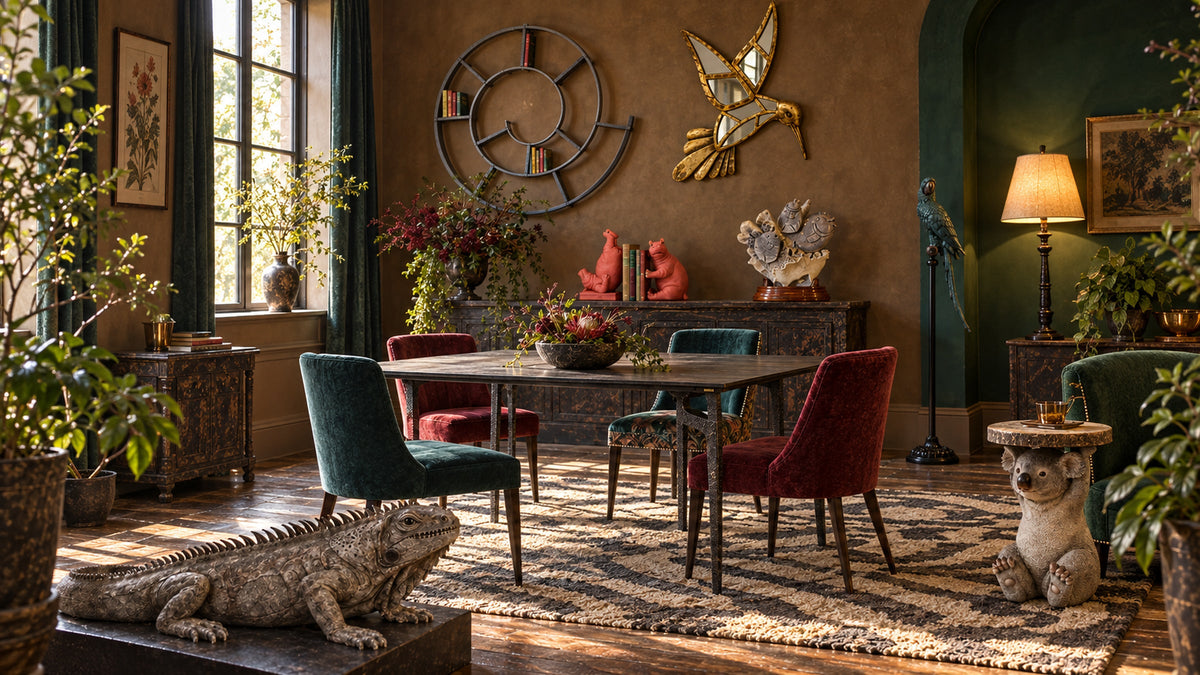
That is visible in a piece such as the Table Bug: its long hammered steel supports make an otherwise restrained dining surface feel tense and insect-like. The Koala side table works in the opposite direction. It is immediately literal—a koala raises a wood-slice top—but the animal’s posture also explains the furniture’s function. And the 135cm iguana does not pretend to be useful at all. Its usefulness is spatial: it interrupts the room so completely that the room must acknowledge it.
When an object seems alive, we treat it differently
The feeling is not entirely metaphorical. Anthropomorphism changes how people relate to possessions.
In a 2010 paper in the Journal of Consumer Psychology, researchers tested what happened when people were encouraged to think about a car in human terms. Participants were less willing to replace the object, and their decisions became less dependent on judgments of mechanical quality. Perceived “warmth”—a trait normally applied in social relationships—began to matter.
That does not mean an animal-shaped table automatically creates a profound bond, or that unusual furniture is psychologically superior. Research on attachment and anthropomorphism is more complicated than that. One later study found that stronger anthropomorphism predicted higher sentimental and instrumental value, which in turn predicted stronger attachment, while its social-exclusion hypothesis was not supported. The useful point is narrower: once an object seems to possess character, people can evaluate it through some of the same emotional language used for living beings.
Anyone who has apologized to a chair after bumping into it, refused to discard a battered mug, or named a car already understands the mechanism. We do not wait for objects to become convincingly human. A posture, a face-like arrangement, or years of shared routine can be enough.
Animal furniture makes that invitation explicit. The koala appears to be working. The bird seems to have just landed. The table appears ready to step away. The object gives the imagination a handle.
The difference between a creature and a gimmick
Not every chair with paws or lamp shaped like a bird becomes meaningful design. The animal can be no more than packaging—a joke exhausted the moment it is understood.
The pieces that last usually contain a second tension. The creature changes the structure. The material carries an idea. The scale alters the room. The workmanship rewards inspection after the silhouette has delivered its first surprise. Function and fantasy push against one another instead of sitting in separate layers.
Context matters too. One strange object in a restrained room can feel astonishing. Twenty unrelated novelties can become visual noise. But a group assembled around a real question—animals that hold, support, reflect, store, or guard—can create the feeling of a collection rather than a theme.
That is why a hummingbird mirror can work beside an abstract spiral shelf and an insect-legged table. They do not match in the conventional sense. They share a behavior. Each refuses to let its function disappear.
The room looks back
Most furniture is designed to become invisible through use. After a few weeks, we stop seeing the table and simply put things on it. We stop seeing the chair and sit down.
Zoomorphic design resists that disappearance. The object retains a small amount of agency—not real agency, but enough visual will to keep reintroducing itself. The rhino still has a desk inside. The sheep still wait in a flock. The bird is still holding up the table.
Perhaps that is why the idea survives every change in taste. We fill our homes with inert things, then give those things legs, eyes, backs, wings, and personalities. We ask them to carry our bodies and belongings, but also to keep us company. We want usefulness, and then we want something more.
Perhaps we make furniture look alive because we do not want the rooms around us to feel dead.
Frequently asked questions
What is zoomorphic furniture?
Zoomorphic furniture incorporates animal forms, anatomy, posture, or behavior into a functional object. It may be literal, like a sheep-shaped seat, or abstract, like a table whose supports suggest elephant trunks.
What is the difference between zoomorphic and anthropomorphic design?
Zoomorphic design draws from animals. Anthropomorphic design gives a nonhuman object specifically human characteristics. Both can make an object seem alive, but an animal-shaped table is not necessarily human-like.
Who are Les Lalanne?
Claude Lalanne and François-Xavier Lalanne were French artists known for transforming plants and animals into sculpture, furniture, jewelry, and functional objects. François-Xavier’s animal furniture included sheep seats, rhinoceros desks, a hippopotamus bathtub, and a baboon fireplace.
Why did ancient furniture have animal legs?
The meaning varied by culture and object. In ancient Egyptian elite furniture, lion and bull legs could convey power, status, religious significance, or generative force—not merely decoration.
Is animal-shaped furniture considered art?
It can be furniture, sculpture, decorative art, or all three. Authorship, material, craftsmanship, conceptual strength, rarity, and the relationship between form and function all affect how an object is understood.
How do you keep animal furniture from looking childish?
Treat it as a strong sculptural presence rather than a theme. Give it space, combine it with serious materials and restrained architecture, and avoid repeating the same visual joke across every object in the room.

Share: