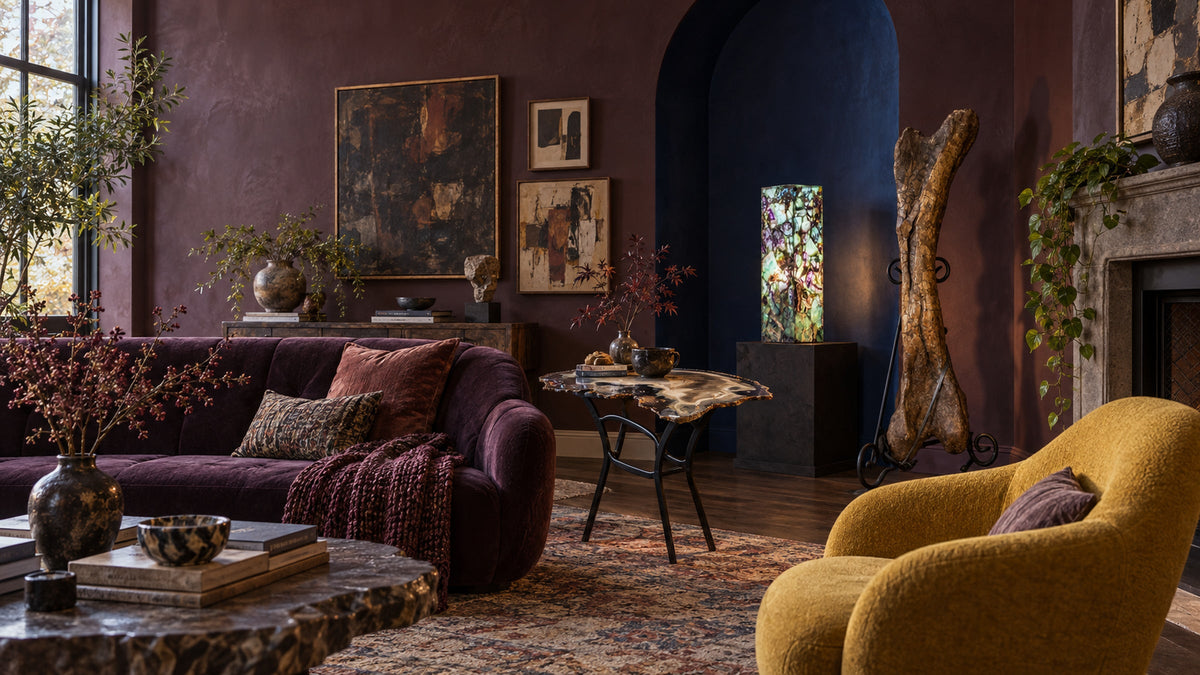

There is a moment in a good room when the furniture stops behaving like furniture.
The chair becomes a character. The lamp throws a small private sunset against the wall. A mineral specimen catches the light and holds it for a second longer than expected. Even the table seems to have an opinion about where it has been placed.
You do not walk into a room like this and think, everything matches. You look around. You move closer. You want to know what something is made from, where it came from, and why anyone thought to put it there.
That feeling has become increasingly familiar in contemporary interiors. Homes are borrowing the language of galleries, while galleries are beginning to feel more like homes. Furniture is being collected with the seriousness once reserved for painting. Fossils, lamps, textiles, ceramics, and strange sculptural objects are being placed together not because they belong to the same set, but because they create a conversation.
This is often called collectible design. The phrase can sound expensive and remote. The actual idea is much more intimate: the useful things around us can also be the things that move us.
The room became one object
Verner Panton did not design rooms by politely arranging furniture inside them. He swallowed the room whole.
In the late 1950s, the Danish designer began developing interiors in which color, light, textile, furniture, wall, floor, and ceiling behaved as parts of one continuous experience. The current Vitra Design Museum retrospective describes Panton's environments as radically new spatial concepts, and its centerpiece is a walk-in reconstruction of his 1970 Fantasy Landscape: an undulating interior with no clear border between architecture and furniture. Vitra Design Museum
The original appeared aboard the Visiona 2, a Rhine riverboat that Panton converted into a vision of future living. Floors rose into seats. Walls softened into upholstered caves. Color moved through the space in warm bands. Panton designed the furniture, textiles, lighting, wall and ceiling treatments—even the atmospheric sound—as a single work. Rather than separating a room into neat functions, he imagined space around well-being, communication, and relaxation. Vitra Design Museum: Visiona
It was excessive. It was theatrical. It was also a rejection of the idea that a home should disappear quietly behind the people living in it.
Panton understood that atmosphere is not a final styling layer. It is the work. A room does not become memorable because every object is beautiful in isolation. It becomes memorable when color, light, form, texture, and movement begin affecting one another.
That is why his interiors still look more alive than many rooms photographed half a century later. They are not waiting to be approved. They are already happening.

The useful object asks to be looked at
A chair has a job. So does a cabinet. That practical obligation has always made furniture slightly uncomfortable in the art world. Is an object still art if someone can sit on it, open it, spill coffee beside it?
Designer Wendell Castle spent much of his career making that question feel beside the point. His sculptural furniture blurred the boundary so completely that the Cooper Hewitt described his Triad chair as both sculpture and functional object. Castle wanted furniture to be collected and appreciated with the same attention given to art. Cooper Hewitt
The Memphis group pushed from another direction. Ettore Sottsass's 1981 Carlton could theoretically hold books, but it also looks like a tiny, brightly colored building performing a balancing act. Cooper Hewitt places it directly on the uncertain border between art and design. Cooper Hewitt
Neither object becomes less interesting because it has a use. The use is part of its tension. A sculptural chair carries the possibility of a body. A cabinet holds traces of what its owner chose to keep. A lamp changes after sunset. Furniture is art that enters the ordinary rhythm of a life.
That intimacy can make design more emotionally charged than an object protected behind glass. We touch it. Move it. Live around it. Years later, a worn armrest or a ring left on a tabletop may carry as much meaning as the original form.
The white cube was never the whole story
Museums traditionally give important objects distance: a white wall, a pedestal, a respectful amount of air. That distance can sharpen the eye, but it removes one of design's most expressive qualities—its relationship to other things.
The Kirkland Museum built its identity around refusing that separation. Its decorative art, fine art, and work by Colorado painter Vance Kirkland were displayed together in salon-style arrangements. As the museum's collection entered the Denver Art Museum, preserving its intimate atmosphere and vignette-style presentation was treated as essential to its future. Kirkland Museum and Denver Art Museum
In those rooms, a painting did not live in one intellectual category while a chair waited in another. Glass, ceramics, textiles, furniture, and art shared the same field of vision. The result felt less like a textbook and more like entering the home of someone with a gloriously specific mind.
Collectible-design galleries have taken this idea even further. Nilufar Depot occupies a 1,500-square-meter former industrial building in Milan, but its exhibitions are theatrical rather than warehouse-like. Work from different eras and aesthetics is allowed to coexist in immersive settings. Nilufar calls the space a laboratory of creativity. Nilufar
For Milan Design Week 2026, the gallery framed objects not as things that merely furnish rooms, but as things that inhabit them—forms, materials, and personal narratives carrying the identities of their makers. Nilufar: Milan Design Week 2026
The Future Perfect has made domesticity part of its curatorial method. Its New York gallery is set inside a five-story 1901 townhouse, where collectible furniture, lighting, ceramics, and sculpture are encountered in residential rooms rather than against the visual silence of a showroom. The Future Perfect
R & Company, also in New York, creates rotating interior environments and works with collectors to build living spaces, not simply object inventories. Its archive holds roughly 10,000 books, periodicals, drawings, models, catalogs, and pieces of ephemera tracing design from 1900 to the present. R & Company
These spaces make a quiet argument: design is understood differently when we can imagine living with it.

Beautiful disagreement
The most compelling rooms rarely behave like well-trained sets. Something is usually a little off.
A severe black-and-white pattern meets a color that feels almost too sweet. A polished surface sits beside something rough and ancient. One object belongs to geological time; another looks as if it arrived from a future that never happened. The room works not because those things agree, but because their disagreement produces energy.
Imagine an agate slab end table beside a soft upholstered chair. The table is useful, but the eye reads the stone first: rings of color, crystalline edges, a slice of deep time standing at sofa height. A fluorite crystal table lamp complicates that relationship again. It is mineral, sculpture, and a source of light; after dark, the material helps create the atmosphere in which it is seen.
Then there is the shock of an object that has no interest in blending in—a 37-inch hadrosaur femur, for example. It changes the scale of the room without taking up much space. The coffee table may be new, the building may be a century old, but the fossil quietly introduces millions of years into the conversation.
This is where an interior begins to feel collected rather than completed.
The goal is not visual chaos. It is friction with judgment. The contemporary exhibition Material Intent: Color and Form at Carpenters Workshop Gallery brings historic and contemporary work together through color, texture, scale, humor, and whimsy. Its premise is that design can move beyond pure utility into emotional territory. Carpenters Workshop Gallery
That does not require a room full of famous names. It requires objects strong enough to retain their identities while living beside one another.
Collecting is not the same as buying the appearance of collecting
There is a version of the gallery-like home that feels strangely empty: every object is unusual, every object is expensive, and none of it seems connected to the person who lives there.
Real collecting is slower and less obedient.
It might begin with a lamp bought because its glow felt like a memory. A chair whose color seemed impossible to leave behind. A stone picked up on a trip, a ceramic made by a friend, an inherited table that technically matches nothing. Meaning arrives unevenly. That unevenness is part of what makes a room believable.
Collecting also asks for attention beyond appearance. Who made the object? What is the material? What tradition, experiment, landscape, or accident produced it? Provenance is not merely a price-making instrument. It is the story that lets an object keep unfolding after the first glance.
The Aesthetic movement argued in the nineteenth century that art should enter everyday life, and designer E. W. Godwin approached the domestic interior as a total work rather than a neutral container. Cooper Hewitt
That idea still feels radical because it places responsibility on the owner. If the room is a composition, taste is not a shopping list. It is a practice of noticing.
Sometimes the right choice is to leave space around one peculiar object. Sometimes it is to let a wall become a chorus. Sometimes two pieces look wrong together for a week and perfect together forever after. A living collection is allowed to surprise its collector.
The room looks back
A home does not need to resemble a museum. It should withstand something a museum never has to: laundry, late-night snacks, muddy shoes, unfinished conversations, people changing their minds.
But the best galleries offer homes a useful permission. The chair may be more than a place to sit. The lamp may set the emotional weather. A fossil can make an ordinary Tuesday feel briefly connected to prehistory. Art does not have to remain at eye level, and design does not have to apologize for asking to be seen.
The living room became a gallery the moment we stopped asking every object to fade into the background.
Perhaps the better question is what happens next—when the gallery becomes lived-in, the collection gathers memories, and the room starts to look unmistakably like no one else's.
Frequently asked questions
What is collectible design?
Collectible design describes furniture, lighting, ceramics, textiles, and functional objects valued for more than utility alone. Authorship, material experimentation, craftsmanship, rarity, cultural importance, and the strength of the idea can all matter. The category includes historic work, limited editions, prototypes, studio pieces, and contemporary objects made at many price levels.
When does furniture become art?
There is no single line. Furniture enters artistic territory when its form, material, concept, or emotional force asks for sustained attention beyond its practical use. Function does not disqualify it; often, the tension between usefulness and expression is what makes the object interesting.
What is the difference between a design gallery and a furniture showroom?
A showroom is generally organized to help customers compare and purchase current products. A design gallery usually builds a curatorial argument, represents specific makers or estates, documents provenance, and places work in historical or conceptual context. Some spaces deliberately combine both roles.
Why do some museums display fine art and decorative art together?
Displaying painting, furniture, glass, ceramics, textiles, and sculpture together reveals how objects from a period or place actually influenced one another. It can also recreate the intimate visual density of a home and challenge the hierarchy that treats useful objects as secondary to fine art.
Who was Verner Panton, and why were his interiors radical?
Verner Panton was a Danish designer known for experimental furniture, lighting, textiles, color, and immersive interiors. His environments dissolved the usual boundaries among furniture and architecture. Projects such as Visiona 2 treated the entire room—surfaces, seating, light, and sound—as one sensory composition.
Does an artful interior have to be expensive or maximalist?
No. An artful room can be quiet, spare, inexpensive, or assembled slowly. What matters is specificity: objects chosen with curiosity, relationships created intentionally, and enough confidence to let something unusual hold attention.

Share: