

The Journal
Why William Morris Wanted Wallpaper to Look Like Wallpaper
Trace the repeating stems and leaves in William Morris wallpaper to see how the pattern works with the flat surface of a wall.

Stand in a hallway covered in William Morris wallpaper and follow one stem with your eye. It turns, slips behind a leaf, then turns up again farther along the wall. You can lose your place in it. What you’re unlikely to lose is your sense of where the wall is. Morris wanted that distinction. The paper could be intricate enough to keep you looking without trying to pass for a view into a garden.

That is the easiest way into William Morris wallpaper design. Look for the shapes that repeat, the spaces between them, and what happens when the pattern meets a door. The question is how a drawing of a plant becomes a surface you can live with.
Why Morris wanted the wall to stay flat
In The Lesser Arts of Life, Morris invites the designer to make a wallpaper’s stems and sprays as elaborate as they like. The condition is right there in his description of the job. The paper goes flat against the wall. The intricacy can come from the way the shapes weave together. It doesn’t need the shading of a branch painted to look as if it could cast a shadow. William Morris, The Lesser Arts of Life (1882).
The V&A sets this argument against the highly naturalistic papers fashionable when Morris began designing. His work still owes plenty to plants that grow in gardens. What changes is the job he gives them. A rose has to belong to a repeat that can continue above a fireplace or down a hallway. V&A, William Morris and wallpaper design.

Trellis gives you a grid. Daisy gives you space.
Start with Trellis. Morris conceived it in 1862, drawing on a rose trellis at Red House. Philip Webb designed the birds. In the Met’s cream-ground example, you can trace the gray lattice even when the stems and roses cross it. Look away and back again. The grid is still the quickest way to find your place. The Met, Trellis and William Morris Gallery’s collection record.

Then look at Daisy. It was Morris’s second design, and it reached production before Trellis. In this example, little clusters of flowers sit against cream. The ground between the groups does much of the organizing. A chest or door can cut off half a cluster and the next intact group still tells you how the wall goes. The Met, Daisy.

How to find the repeat in a William Morris wallpaper
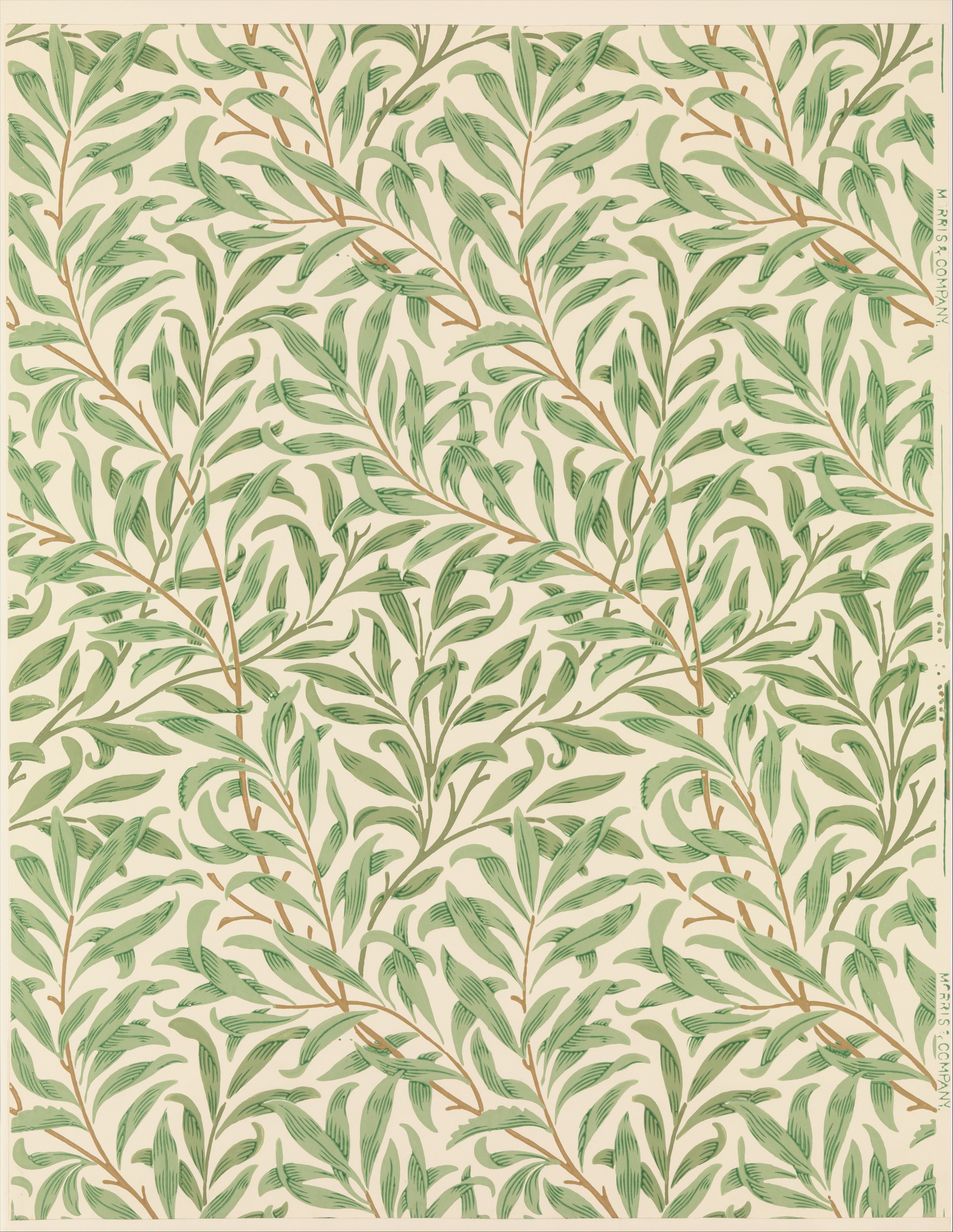
Put your finger beside a conspicuous leaf or a bend in a stem. Then find the next identical bend, with the same leaves around it and the same gap on either side. A neighboring leaf can look similar without being the place where the pattern starts again. Try it with Willow Bough. Follow the long direction of one branch before you look for its return. The Met, Willow Bough.
Do the same thing with Marigold and Larkspur. When you lose your place in one, notice what brings you back. It might be a recognizable flower or a distinctive turn in the foliage. The important comparison is what you can still pick out after taking a few steps back. At that distance, a paper you loved for one tiny flower may work mainly as a field of stems and small patches of color. The Met, Marigold and The Met, Larkspur.


What block printing has to do with the repeat
Look at a printed rose and then at the border of the paper. The design has to line up in two ways. Its printed colors have to meet where the design calls for them, and the finished design has to join the next impression. A single beautiful flower won’t get the paper around the room. The V&A’s demonstration makes that patient sequence easier to see. V&A, A brief history of wallpaper.

Color can change the reading even when the drawing stays the same. Cooper Hewitt’s Morris sample book shows Trellis on several grounds, including blue, dark gray, taupe and off-white. If you’re looking at a contemporary version, check the colorway you’re actually considering. The name on the roll tells you which design you’re looking at. The sample tells you what will happen beside your woodwork. Cooper Hewitt, Trellis by William Morris.
Read the paper from the doorway before you choose it
Ask for a sample large enough to show a full repeat. If you can, hold two strips together according to the maker’s match instructions. Stand where you normally enter the room. Can you still find the branch you liked? Does the doorway break the pattern at a place that looks abrupt to you? Move the sample beside the trim and try again. It’s easier to judge the wall from there than with a small square flat on a table.

I’d do one more check from the next room. The little fragments of paper you see around the casing are part of how you’ll experience it most days. If the pattern still makes sense in that narrow view, the wall has a good chance of being interesting at both distances.

A Morris pattern you can live with in a frame
If the wall needs to stay plain, a framed repeat lets you look at the pattern up close. Peacock and Dragon is a Morris textile design, and this framed poster reproduces it. A frame changes the experience. You can see where the composition ends, then move it to another wall when you feel like it.

For more of the plants and people behind these designs, read William Morris botanical patterns, from Trellis to Strawberry Thief.
Questions about William Morris wallpaper
What was William Morris’s first wallpaper design?
Trellis was his first design. Daisy was the first wallpaper the firm produced. The distinction is between when Morris conceived the design and when a customer could buy it.
Why are the flowers stylized?
Morris drew on real plants and historical ornament. He arranged the leaves and stems for a surface that repeats across a wall. A recognizable plant could still bend and return in a way that made sense for a sheet of paper.
How can I tell where the wallpaper repeats?
Find the same distinctive feature twice, then check the shapes around it. For an actual installation, use the current manufacturer’s repeat measurement and match instructions. Museum sheet dimensions describe the object in the collection.
Is Strawberry Thief a wallpaper or a fabric?
Morris designed the original Strawberry Thief as a furnishing textile. The pattern may be familiar from other formats today. The original medium is part of how to read the design. V&A, William Morris textiles.


